 |
The Basics of Model Railroading: Getting Started

I know you're excited about model railroading now and anxious to get started, but before you rush out and buy your first train set, there are a few things to think about...
If you are just beginning your adventure into modeling trains and railroads, you may wish to check out the Overview page. In addition, there are a few basic things to know that will help you in your decision-making when it comes to model railroad planning and design.
Three major concepts to think about as you plan your model railroad...
~Display
Theme
The first thing you should do is decide on a theme for your railroad.
~What is your railroad's purpose? Where are your trains going to and coming from and why? Are they going to carry passengers from one town to another? Will they mostly carry coal to towns or local ports, timber to lumber yards, or farm goods to markets, etc?
~What is the setting: the location and era? Where and during what time period will your trains be operating? These can be either specific or general. If you like steam trains you will want to model the era before 1955. Diesels became popular in the late 1940's and beyond. The period between 1945 and 1955, the transition era, saw both steam and diesel running the rails. The location you want to model would help you decide which particular railroads - like Union Pacific or Norfolk Southern, etc.- you want running through your layout.
~What kind of model trains or equipment do you want to run on your layout? Again the place and the time you want to model may help you decide. Or it could be the other way around. You may really want to model the Lehigh Valley Railroad because you like the colors, for example, in which case the general location and time frame would already be known.
~What type of service will your model railroad provide and to whom? What industries and/or towns will your trains be carrying goods (or people) to and from? Do you like coal-hauling, logging, farming, oil industries, passenger service?
These are very important decisions that will lay the foundation for how you will design and build your layout. For more info on this subject, see the "Design" page.
Scale
You then need to decide on what scale to use. (Scale refers to the ratio between the measurement of a model compared to that of the prototype.) In other words what size trains do you want to run?
There are several different popular train scales available. Which one you choose depends on the following:
a) how much space you have,
b) how much money you can comfortably devote to the hobby,
c) whether you like a lot of scenery vs. more emphasis on the trains,
d) whether you would prefer long running trains or shorter trains, and
e) whether you have the patience, the visual acuity, and finger dexterity to deal with very tiny engines on tiny tracks.
Incidentally, the words scale and gauge are often confused.
Scale refers to the ratio between the measurement of a model compared to that of the prototype.
Gauge is the term used to describe the distance between the 2 rails of track - usually 4 ft 8-1/2in ("standard gauge") in the prototype. "Narrow gauge" is a term used for rails that are closer together than standard gauge - usually around 3 to 3 1/2 ft.
To get more detailed information to help you decide on what scale to use, go to the "Scales" page.
Displays
The third thing to decide in your model railroading adventure is how you will show off and operate your trains.
Do you want a huge wall-to-wall empire, or a small switching layout on a shelf (See Shelf Layouts for Model Railroads, by Iain Rice), or something in between? There are other possibilities and considerations as well...
Are you building this railroad for your own enjoyment? Will you have friends helping you and participating in the operation of the railroad when it is completed? Is it mostly for your children or grandchildren to enjoy? Will it become part of a larger club layout? Do you want to build a small scene that you could sell at a craft show or on eBay?
There will most likely be some limiting factors that may enter into this decision also, such as space, time and monetary considerations.
For more on this subject and some examples, check out the "Displays" page.
NMRA Standards
While you are planning and designing your model railroad, it is important to remember that there are standards that have been developed by the National Model Railroad Association that will help you considerably in assuring that your trains run smoothly and without derailments.
Some of these standards are mentioned below but be sure to visit the NMRA.org website to learn a lot more. In fact, If you are serious about model railroading, you should really consider joining the NMRA as a member.
Join the NMRA
There are many benefits to being a member of the NMRA including discounts at train and hobby shops, local, regional and national meetings where you can learn much more about model railroading, attend how-to clinics, see what other model railroaders are doing, visit other layouts, get a subscription to a monthly model railroading magazine and make many friends while you are at it.
Helpful Standards
Here are some helpful standards established by the NMRA that will assist you in your model railroading. These are just a few - there are many more...
- Standard gauge tools to be sure your rails are the proper distance apart
- How far apart parallel tracks and curved tracks need to be
- What weight should your railcars be to help them stay on the tracks better
- What are the proper grades and clearances to avoid mishaps on your railroad
- coupler height gauges and information to be sure your cars and locomotives can hook up to each other properly
- how to build a modular sectional layout properly so that you can take it to a model train show and it will fit in perfectly with the other modules that other people bring.
- Learn the standards required to win achievement awards for your modeling efforts.
Learn more on the NMRA page on this site.
Model Railroading Terms
There are a lot of terms used in model railroading and railroading in general that you may not be familiar with. Here is a page containing some of the lingo and the definitions. (Some terms that railroaders use were purposefully left out because this is a family website;)
"Givens and Druthers"
So you can see there are many things to consider when deciding what kind of railroad you want and how you want to show it or operate it. However, don't get so hung up on the decision-making process that it prevents you from moving forward. Like they say in the commercial, once you have considered the options, "just do it".
Okay, now that you have considered the location, the era, the scale and what type of display you want to model, you're ready for the next step. Go to your local hobby shop or click on the link and pick out your train set.
This will get you started. Then, after you have set that up and had some fun with it, read more on this site about how to expand your set into a realistic track plan, construct benchwork for it and enhance it with mountains and scenery, light up your buildings and passenger cars. Now you're talking! You'll never be the same again!
If you would like to introduce your small children to the fun of making crafts, models and dioramas, you may wish to visit the webpage at Homeschool-Activities.com for some ideas that may lead them into model railroading later.
A Quick Synopsis of how to get started:
One of my visitors asked me, "How do I get started building an HO layout with two mainlines - one passenger and one freight?"
Here was my reply...
I would start with 2 regular HO train sets - one freight and one passenger. I like Kato tracks the best but Atlas and Bachmann are good too and are a little less expensive. I have become a fan of tracks with plastic roadbeds, like Snap-track and E-Z Track. They are easy to put together and they stay together with less risk of derailments. For power, you could just start with regular analog DC transformers that come inside most regular commercial train sets. You can always upgrade to better transformers later. The main advantage of starting off with DC is that it is less expensive and easy to set up if you're only going to run two trains on separate mainlines. If you are pretty sure that you are going to stick with the hobby and grow into a larger layout running 4 or more trains at the same time, you should seriously think about starting with DCC. It is a little more expensive to start with but you will save money in the long run. Most people that started with DC and later switched to DCC say they wasted a lot of money in the beginning buying DC locomotives that they can't use anymore on their DCC layouts.
Now, use some paper and pencil and draw out a sketch of the type of layout you wish to create - put down where do you want to put roads, buildings, mountains, rivers, etc. Make it interesting but not too big and not too complicated. The more complicated it is, the more difficult it will be for you to manage your trains and to troubleshoot problems, not to mention the fact that large detailed layouts take forever to build.
For your benchwork, I like the Woodland Scenics modules (Mod-U-Lar) that are easy to put together and easy to add on to later if you wish. Get some foam sheets from your local construction store and ask them to cut the sheets to fit the top of your benchwork. While you’re there ask them to cut plywood sheets for you in the same dimensions. Then put the plywood sheets down on top of the benchwork and lay the foam sheets on top.
Now you’re ready to start laying the track according to the trackplan that you’ve sketched out. Once you’ve got the track where you want it, check it out by running your trains back and forth on those tracks to be sure there are no problems. Make sure that your track curves are far enough apart so that when the trains are running beside each other they don’t crash or knock each other over. This is especially important with passenger trains because the cars are longer and the middle of the cars can sideswipe your freight cars on the other track. Make sure that the wiring to the tracks is all foolproof and that the trains run perfectly in both directions. Now is the time to troubleshoot because it’s much more difficult later to tear up and replace track that wasn’t put down properly. If your plan involves ramps and bridges, you want to create those now and make sure they are secure and foolproof as far as running trains is concerned. Then glue all the tracks, ramps and bridges in place. Be very careful not to get any glue on the rails and especially not on any of the switches (turnouts). After it all dries, run the trains again and make sure there are no problems. Then you can start building your scenery which is what really defines how your layout looks.
For details on all this, check out the first 8 or 9 categories on the building-your-model-railroad.com website. As you get more advanced with your layout, you can add railroad signals, automated starts and stops and lot of other fun things, but get the basic layout done first and always make sure your trains can run flawlessly every time you add or change something. You never know when friends are going to come by and want to see your trains.
Most of all have fun!!
Updated May 5, 2025
Back to Home Page
Contact Me | Blog | Photos | References | Supplies | GiftShop | Sitemap | Search | Comment | Privacy Statement | Disclosures
Overview of Basics...
Model Railroad Layout Overview: Step-By-Step
Building a Model Train Layout with Your Children
Model Railroad Club: How to Get Started
Beginner's Guide to Model Cars.


Sign up for our free monthly newsletter ...

This unique Model Railroad Museum was established in November of 2024 as a non-profit community organization featuring ten operating model railroads in all the different major scales, a STEM Program for students, historical displays, group tours and clinics on how to develop your skills as a model railroader. It's definitely worth a visit if you're in the area.
Open 12-6 pm on all Fridays, Saturdays and Sundays through April, 2026. They will be moving to a new location after that. Will provide an update later this year.
Update: Aug. 2. 2026. Unfortunately, the MacArthur Center where our Museum was located has closed and we have been forced to evacuate our space there. Until we can find a more suitable place, we are temporarily located in a small office/store at 750 Lord Dunmore Dr., Unit #109, Virginia Beach, VA 23464. Our multiple layouts have been dismantled and are in storage nearby. The good news is that we have many items that are available for sale at greatly discounted prices. Our hours of operation are 2pm to 5pm, every Mon, Weds, Fri, and Sat except major holidays.The proceeds will be used to create a new and better museum once we have found the right location.

Tracks Newsletter: Sign Up Here!

√ = ad or sponsored link
What's New on BYMRR.com?
Recent Articles


-
Model Railroad Supplies
Oct 01, 26 05:30 PM
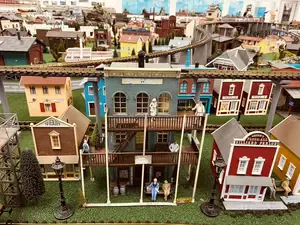 We have started a new store to help you build your layout and teach your youngsters about science with STEM products.
 -
common-steam-locomotives-of-the-1940s-and-1950s
Apr 14, 26 04:27 PM
Common Steam locomotives of the 1940s and 1950s -
BYMRR-Store
Mar 22, 26 01:22 PM
 New model railroad store created by model railroaders for model railroaders.
Building Your Model Railroad
